
About us
The critical role of the Southern Ocean in the Earth System highlights the need for sustained, integrated and multidisciplinary observations. Due to the size of the Southern Ocean, this requires international agreement on the priority observations to be collected, and also internationally coordinated data management and delivery. These data and observational needs provided the basis for establishing the Southern Ocean Observing System (SOOS) as a coordinating body to enhance and ensure the delivery of Southern Ocean data across nations, organisations, programmes and stakeholders, and to provide the infrastructure for organisation of community networks to develop sustained observing systems and syntheses of existing Southern Ocean datasets.
Developed over many years, the Southern Ocean Observing System (SOOS) was officially launched in August 2011 with the opening of the International Project Office (IPO), hosted by the Institute for Marine and Antarctic Studies (IMAS), University of Tasmania, Australia. SOOS is a joint initiative of the Scientific Committee on Oceanic Research (SCOR) and the Scientific Committee on Antarctic Research (SCAR).
The myriad of programs that focus on particular aspects of the Southern Ocean is extensive, and covers both the Antarctic community (traditionally focused south of 60ºS and coordinated predominantly by SCAR and the Antarctic Treaty System (ATS)), and the oceanographic community (traditionally focused north of 60ºS and coordinated predominantly by SCOR and the Intergovernmental Oceanographic Commission (IOC)). SOOS bridges these two communities, and builds networks that integrate across the historical boundaries.
Since the beginning, SOOS has built a network of stakeholders and contributors, all working together to achieve the community-defined mission and objectives.
The SOOS Mission
The SOOS mission is to facilitate the sustained collection and delivery of essential observations of the Southern Ocean to all stakeholders, through the design, advocacy, and implementation of cost-effective observing and data delivery systems.
Working towards the overall vision for “sustained observations of dynamics and change of the physics, chemistry, biology and geology of the Southern Ocean system should be readily accessible to provide a foundation for enabling the international scientific community to advance understanding of the Southern Ocean and for managers to address critical societal challenges”. Specifically, SOOS enhances the collection and delivery of Southern Ocean observations by:
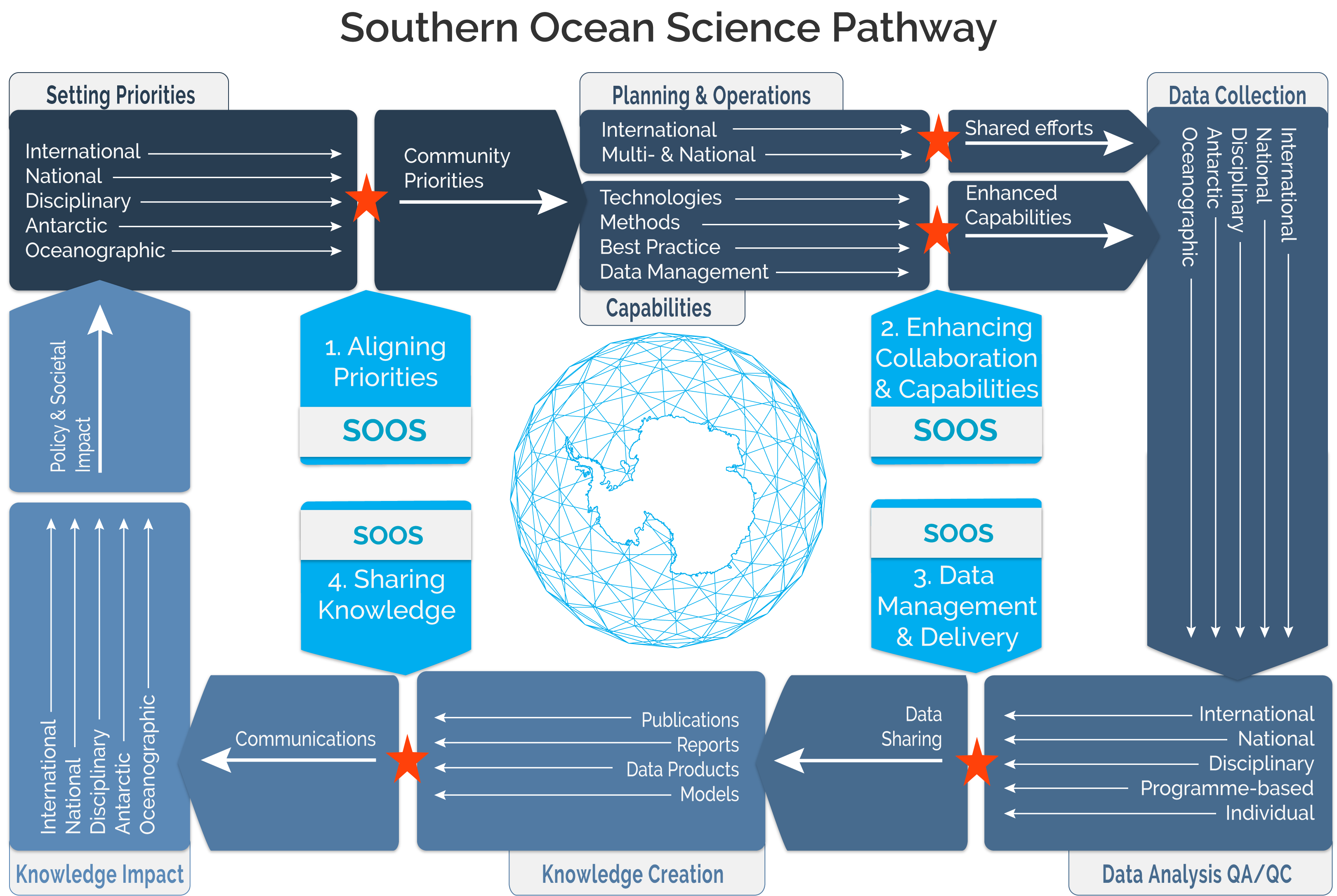
| 1. | Aligning, advocating, and supporting scientific and observational priorities to provide a unified voice to funders, national programs, and intergovernmental agencies through publications, research endorsement, alignment of observing system requirements, and advocacy |
| 2. | Enhancing collaboration and observational capabilities by building integrative networks, developing collaborative tools, supporting capacity development opportunities, and facilitating efficiencies in sensor, platform, and data technologies |
| 3. | Ensuring the management and delivery of observational data by connecting data repositories, rescuing unpublished data, and encouraging the use of FAIR data principles |
| 4. | Sharing knowledge within the Southern Ocean community and beyond, to provide visibility and enhance the impact of Southern Ocean research and the knowledge created from it, through communication strategies, workshops, publications, and community coordination efforts |
The SOOS Vision
“Sustained observations of dynamics and change of the physics, chemistry, biology and geology of the Southern Ocean system should be readily accessible to provide a foundation for enabling the international scientific community to advance understanding of the Southern Ocean and for managers to address critical societal challenges”
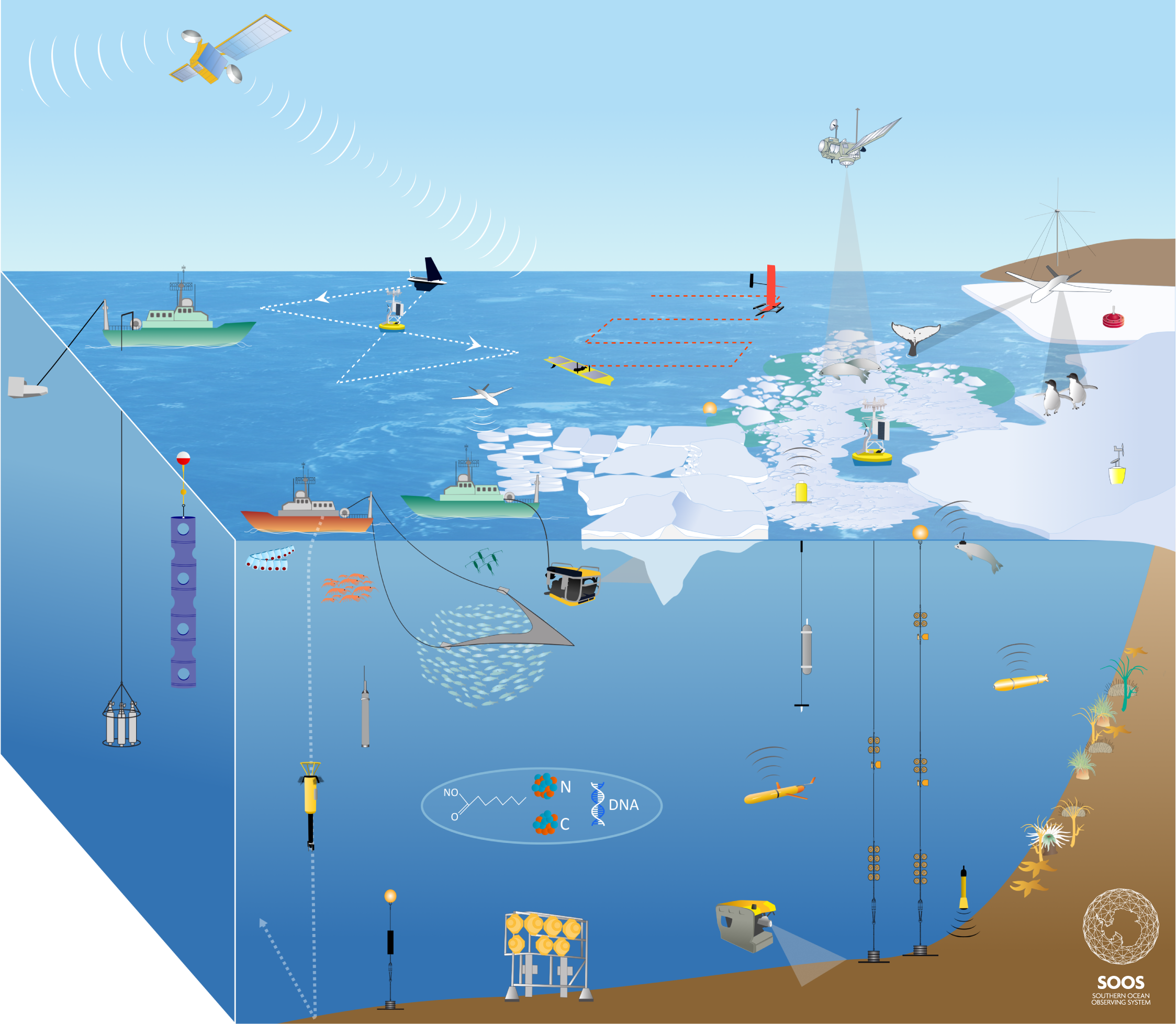
In 2013, SOOS published its vision for the future, outlining the long-term goal of SOOS, the gains inherent in its implementation, and how the international community can move towards achieving it. The SOOS vision is nicely summarised in the schematic on the right. It shows a cyberinfrastructure-based vision for SOOS, where marine assets would include a mixture of both autonomous and non-autonomous platforms, but relying more heavily on the former over time. Combined with satellite remote sensing, the data would be relayed to ground stations in real time, where assimilating ocean models would produce near real-time state estimates of each of the parameters in the system. The error fields associated with these assimilating models would then be used to re-task the autonomous platforms in real time, thus maximising the spatial-temporal coverage of each of the parameters being measured, without specific need for human intervention.
The above vision is many years away, and it behoves us to work towards it progressively, yet strategically. Significant advances in cyberinfrastructure, modelling and observation technologies are needed to achieve the required capabilities. Further, international cooperation, infrastructure and investment are critical for the success of SOOS.
The SOOS Values
Central to the SOOS mission is a set of values that are shared by SOOS and form the basis for our collaborations with, and recommendations to, the broader community. This includes our stakeholders which include the research community, managers of marine resources, policy makers, local planners, ship operators, Antarctic tourism operators, weather and climate forecasters, educators, and international organisations, including the International Oceanographic Commission of UNESCO, the World Meteorological Organisation, Scientific Committee on Oceanic Research, and the Scientific Committee on Antarctic Research.
SOOS commits to:
Support and advocate for active engagement with all interested nations, programs, organisations and projects across all relevant disciplines, industries, and stakeholders, including under-represented groups.
Appropriately invest resources, time, and effort to ensure engagement with and representation of the broader Southern Ocean community in SOOS, and actively contribute to efforts to improve equity, diversity and inclusion (EDI) in that community.
Contribute to and advocate for the development, adoption, and continual improvement of best practices in ocean observing and data management, including sharing of resources and knowledge and championing open and FAIR access to data and data products.
| ⇒ | To achieve the SOOS mission and to focus scientific efforts, 5-year strategies are developed, which define the actions of the SOOS community during that period. For further information, have a look at our recent and past Science and Implementation Plans. |